
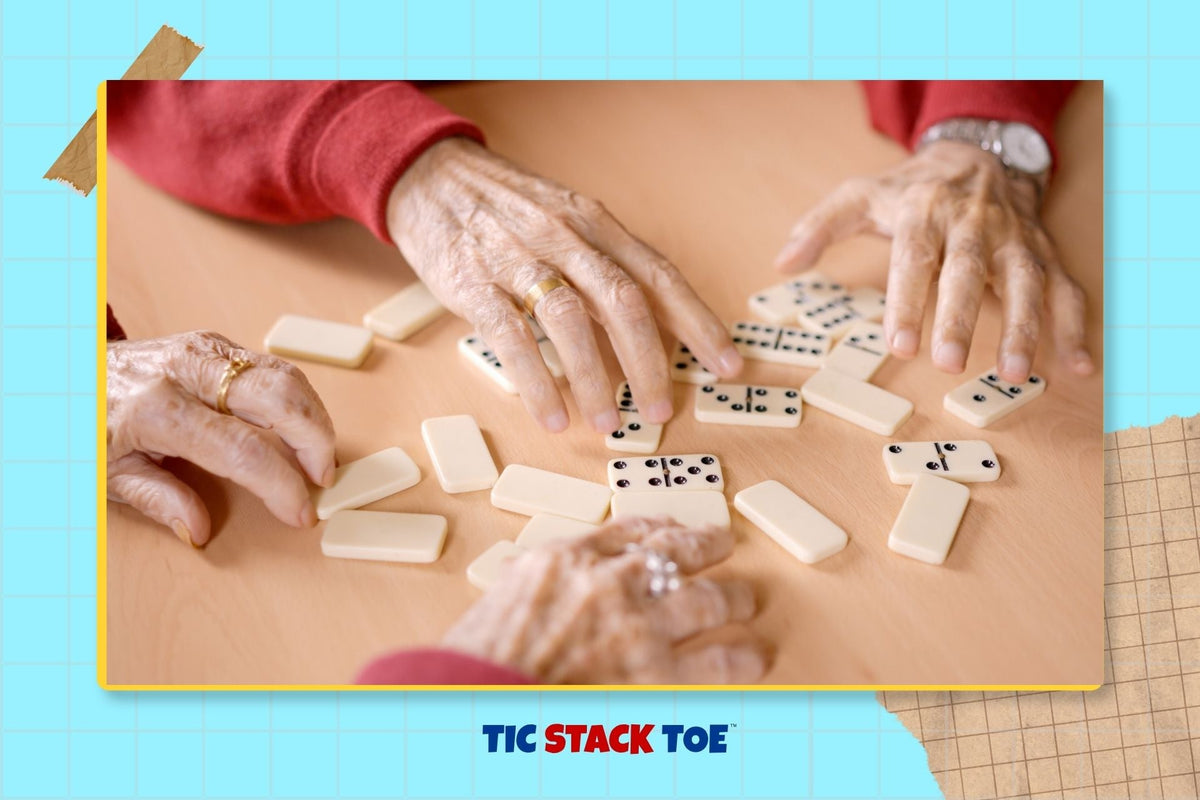
Most "games for seniors" lists quietly assume the player can stand at a table, reach across a full board, or manage small pieces with steady hands. That assumption rules out a lot of people who'd otherwise enjoy playing. Reduced grip strength, a shorter reach, or trouble standing doesn't shrink someone's interest in games, it just narrows which formats actually work, which is a more specific question than "games for seniors" usually answers.
This isn't a general roundup of senior-friendly games. It's a narrower list, built around one question: what still works when reach, standing, and fine motor control are the limiting factors, not interest or ability to play. Here's what holds up, and why some tabletop games are better suited to a seated setup than others.
What "Limited Mobility" Actually Changes About Game Choice
Mobility limitations affect games in a few specific ways, and it helps to name them rather than treat "limited mobility" as one vague category. Some games require leaning or reaching across a wide board to move pieces on the far side. Others need someone to stand up and walk around a table, reset a board, or retrieve dropped pieces from the floor. Fine motor tasks - picking up small tiles, holding a fan of cards, flipping tiny tokens - can be difficult with arthritis or reduced grip strength.
None of that rules out playing games. It just changes which ones make sense. A game that stays within arm's reach on a small board, uses pieces sized for an easy grip, and never requires standing to finish a round removes most of the friction before it starts. That's a different filter than "easy to learn," and it's worth applying on its own.
Tabletop Games That Ask the Least of Reach and Grip
A few familiar games already fit this profile well. Dominoes stay flat on the table, involve large enough pieces to grip comfortably, and don't require reaching past a partner's side of the board. Checkers works from a seated position for the entire game, though the board size can be a factor - a compact set keeps every square within reach. Card games played with a card holder (a small stand that lets someone view a hand without pinching multiple cards at once) solve the grip problem directly rather than working around it.
Bingo is worth mentioning too, since it's often played in group settings like senior centers specifically because it needs almost no fine motor control beyond placing a marker. The common thread across all of these is that the physical demand is decided by the format, not the rules - a large-print, large-piece version of nearly any classic game changes who can play it comfortably.
Why a Stacking Board Works Well for a Seated Setup
Tic STACK Toe fits into this same category for a specific reason: the entire board is small enough to sit within arm's reach on a table, and the stacking mechanic uses game pods sized for an easy grip rather than small flat tiles. Placing or stacking a pod is a single, deliberate motion - no leaning, no standing to reset the board between rounds, and no reaching across a partner's side to make a move.
The gameplay itself also works in favor of a seated setup. Because players can reclaim a space by stacking on top of an existing pod, a round rarely drags on - the game tends to resolve in a handful of moves once someone commits to a strategy, which matters if sitting upright at a table for an extended stretch isn't comfortable. It's screen-free, doesn't require reading small print, and resets in seconds rather than needing pieces gathered up and rebuilt from scratch.
Games That Ask Almost Nothing of the Body
On days when even small, repeated movements are tiring, word and trivia formats are worth having on hand. Simple word-association games, trivia card decks organized by decade or category, and guessing games like twenty questions need essentially no physical setup - someone can read a card or ask a question without picking up a single piece. These work well paired with a lower-effort tabletop game rather than replacing it, since alternating between "sit and talk" and "sit and play" keeps a visit from feeling like one long activity.
These formats are also useful for mixed-ability groups, where one person may have more mobility limitations than another. Nobody is left out because the format never asked anyone to reach, stand, or grip something small in the first place.
What to Look for When Choosing a Game
A few practical questions make this kind of search faster the next time it comes up:
- Does the entire board fit within a comfortable arm's reach from a single seated position?
- Are the pieces sized for a grip that doesn't strain with arthritis or reduced hand strength?
- Does finishing a round require standing up, walking around the table, or picking pieces up off the floor?
- Is the print or piece color large enough to see clearly without straining?
Running through this list before buying or bringing a game to a visit catches most of the mismatches early. It's also a useful checklist for anyone shopping for a senior center or care setting, where games get used by a wide range of ability levels in the same session. If you're stocking a shared space and want a hand narrowing the options, reach out and we can help.
For a broader look at options across ability levels, our board games for seniors guide covers additional picks beyond the mobility-specific ones here.
Getting Started
The easiest way to introduce any new game in this category is to keep the first round short and low-pressure - a single game of dominoes or one round of a stacking board is enough to see whether the format actually feels comfortable, before committing to a longer session. Watch for where someone hesitates: reaching for a piece, holding a card, or standing to reset the board usually points to exactly which constraint matters most for that person.
The National Institute on Aging lists playing games alongside reading and learning new skills as one of several everyday activities that can help keep the mind engaged as people age - a reasonable case for keeping a few of these within easy reach, regardless of which one ends up being the favorite.
If you want to see the full range of options, Tic STACK Toe is worth a look for anyone assembling a small collection of seated-friendly games.


Leave a comment
This site is protected by hCaptcha and the hCaptcha Privacy Policy and Terms of Service apply.